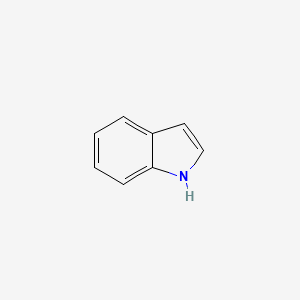
| Metabolic Pathways |
|
| Structure |
|
| IUPAC Name |
1H-indole |
| PubChem CID |
798 |
| Synonymous Names |
more
less
|
| Formula |
C8H7N |
| Molecular Weight |
117.15 |
| Chemical Class |
Benzenoid, Aromatic, Indole |
| Reference Link |
- Degen, T., Dillmann, C., Marion-Poll, F., and Turlings, T. C. J. 2004. High genetic variability of herbivore-induced volatile emission within a broad range of maize inbred lines. Plant Physiol. 135:1928–38
- Altenburger, R., and Matile, P. 1990. Further observations on rhythmic emission of fragrance in flowers. Planta. 180:194–7.
- Bergstrom, G., Birgersson, G., Groth, I., and Anders Nilsson, L. 1992. Floral fragrance disparity between three taxa of lady’s slipper Cypripedium calceolus (orchidaceae). Phytochemistry. 31:2315–2319.
- Huang, J., Cardoza, Y. J., Schmelz, E. A., Raina, R., Engelberth, J., and Tumlinson, J. H. 2003. Differential volatile emissions and salicylic acid levels from tobacco plants in response to different strains of Pseudomonas syringae. Planta. 217:767–75.
- Connick, W. J., and French, R. C. 1991. Volatiles emitted during the sexual stage of the Canada thistle rust fungus and by thistle flowers. J Agric Food Chem. 39:185–188.
- Suckling, D. M., Twidle, A. M., Gibb, A. R., Manning, L. M., Mitchell, V. J., Sullivan, T. E. S., et al. 2012. Volatiles from apple trees infested with light brown apple moth larvae attract the parasitoid Dolichogenidia tasmanica. J Agric Food Chem. 60:9
- Giacomuzzi, V., Cappellin, L., Khomenko, I., Biasioli, F., Schütz, S., Tasin, M., et al. 2016. Emission of Volatile Compounds from Apple Plants Infested with Pandemis heparana Larvae, Antennal Response of Conspecific Adults, and Preliminary Field Trial.
- Michereff, M. F. F., Laumann, R. A., Borges, M., Michereff-Filho, M., Diniz, I. R., Neto, A. L. F., et al. 2011. Volatiles mediating a plant-herbivore-natural enemy interaction in resistant and susceptible soybean cultivars. J Chem Ecol. 37:273–85.
- Strapasson, P., Pinto-Zevallos, D. M., Da Silva Gomes, S. M., and Zarbin, P. H. G. 2016. Volatile Organic Compounds Induced by Herbivory of the Soybean Looper Chrysodeixis includens in Transgenic Glyphosate-Resistant Soybean and the Behavioral Effect on
- Pingault, L., Varsani, S., Palmer, N., Ray, S., Williams, W. P., Luthe, D. S., et al. 2021. Transcriptomic and volatile signatures associated with maize defense against corn leaf aphid. BMC Plant Biol. 21:138.
|
| Plants/Microbial Species and Abiotic/Biotic Stimuli |
| Plant/Microbial Species |
Abiotic/Biotic Stimuli |
| Zea mays |
Insect - Spodoptera littoralis |
| Nicotiana tabacum (Tobacco) |
Bacteria - Pseudomonas syringae |
| Citrus medica (Citron) |
None |
| Cypripedium calceolus (Lady's slipper orchid) |
None |
| Cirsium arvense (Canadian thistle) |
None |
| Malus domestica (Apple) |
Insect - Epiphyas postvittana - Light Brown Apple Moth |
| Malus domestica (Apple) |
Insect - Pandemis heparana |
| Glycine max (Soybean) |
Insect - Chrysodeixis includens - Soybean Looper |
| Zea mays |
Insect - Rhopalosiphum maidis - Corn Leaf Aphid |
|
| Confirmed/Hypothesized Functions |
|